

I think of Mark Twain as emblematic of America’s divide: between urban and rural, between white collar and blue collar, between coastal cities and flyover country. One of my old professors observed that Twain could write a sentence that would bowl over any Ivy League literary critic, but chose instead to write in an American vernacular — which the sophisticated New England literary circle of his day considered “vulgar” and “trash.”
In the discussion of Benito Cereno a few weeks ago, I noted how the narration in Huckleberry Finn often confuses readers into believing he was some racist hick, which tends to happen with writers in middle America. Critics heap praise on a select few — Twain, Faulkner, Cather — but more often than not consider writers “provincial” if they live outside a few cultural centers.
For consideration, how many other writers from Missouri can you name? There’s a sub-genre of Ozark literature, and Franzen put St. Louis on the map, but can you name a writer celebrated by the New York Times and the Washington Post who lives in some non-college town in Missouri?
You can’t rule out a selection bias, where authors who are going to “make it” end up in New York or Boston or academia, but I’m also reminded of a southern bookseller friend who once said of her negotiations with New York publishers, “It helps if they think you’re stupid.”
Samuel Clemens as Mark Twain
Samuel Clemens famously was born in 1835, the year of Halley’s Comet, and died in 1910 when the comet passed the earth again. That coincidence has given his life a little sparkle in the annals of American literature, as though he were a man destined for greatness.
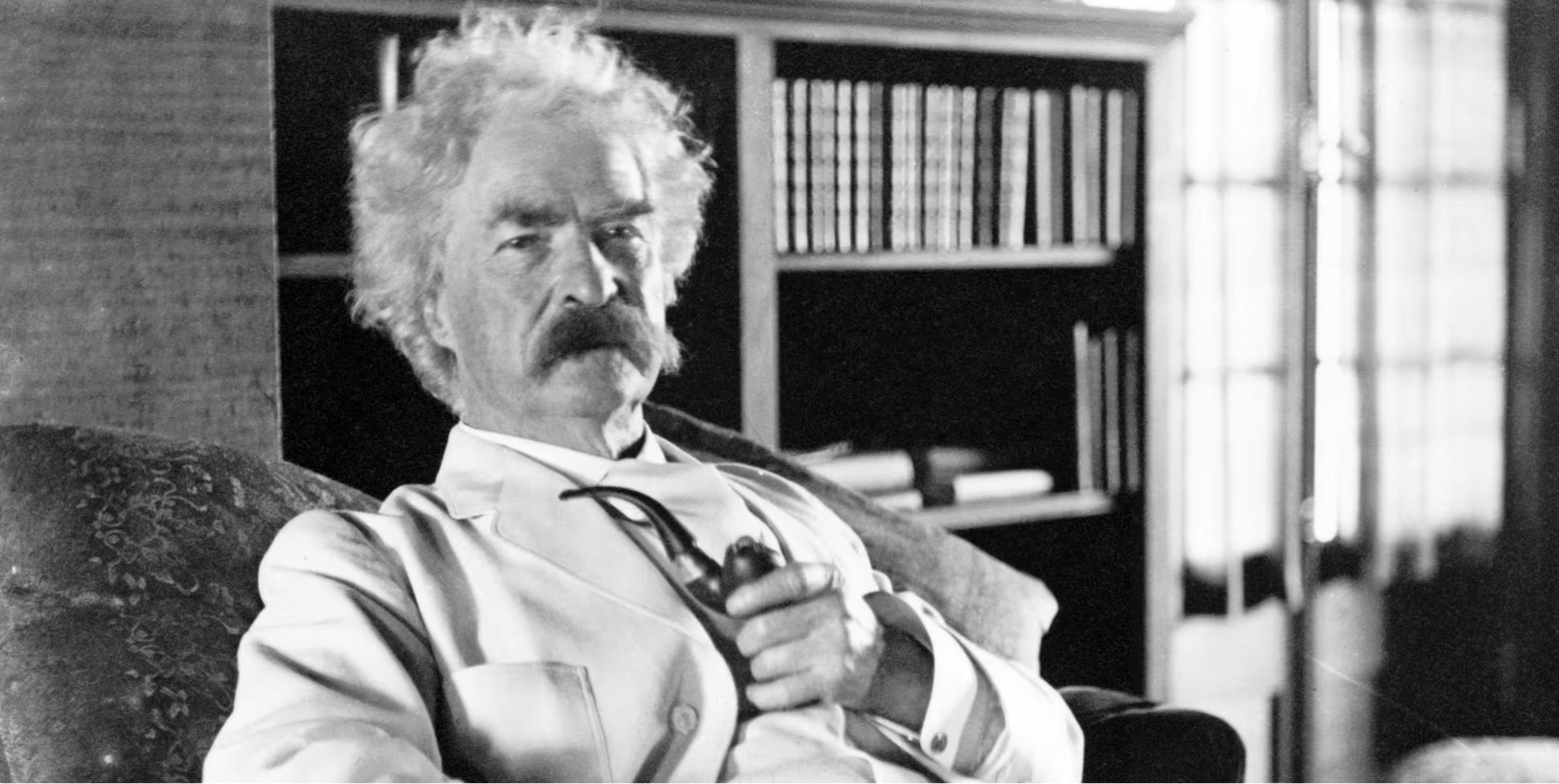
He was born and raised in Missouri, which was then the American frontier, and his childhood years must have lodged in his imagination, as they inspired many of his most famous works, including The Adventures of Tom Sawyer and Adventures of Huckleberry Finn.
As a young man he knocked around a bit — as a newspaperman out east, as a riverboat pilot on the Mississippi, and as a miner out west. In his early 30s, he took a steamship tour of Europe to write travel essays (collected as The Innocents Abroad).
He met his wife, had children, and settled down as a writer and critic in Hartford, Connecticut, where he made a pile of money — much of which he lost speculating on publishing and typesetting inventions. As an idea of his wealth and loss, the Wikipedia article says he invested today’s equivalent of $9 million in a business failure.
Facing bankruptcy, he had to go on the speaking circuit late in life, and I wonder if those speaking engagements helped solidify his reputation. He apparently hobnobbed with many of the movers and shakers of the Gilded Age, although his views seem to have turned darkly anti-establishment in his period.
A Word on James Fenimore Cooper
The posts from the past few weeks have been about classic American short stories, so James Fenimore Cooper is out of scope for me right now. I may one day review one of his novels, perhaps The Last of the Mohicans and The Pathfinder, whose character Natty Bumppo is the prototype for the western hero.
I bring him up today because Twain has a famous essay called “Fenimore Cooper’s Literary Offenses,” in which he excoriates Cooper’s prose. I’ve not read much Cooper so cannot comment on the accuracy of Twain’s critique, but it feels a little unfair given that Cooper was writing at a time when there was no American literary tradition to draw from — and no real audience for the sophisticated high art of, say, a Henry James.
One conclusion from the Twain-Cooper beef is that there is a long tradition of writers grappling with aesthetics and the artistic prowess or failures of their forebears. Readers interested in Twain should read this essay for a glimpse into how he viewed the art of prose — but also how he views literary criticism.
In the epigraph to his essay, Twain quotes two professors and the writer Wilkie Collins praising Cooper, and you get the feeling Twain merely wanted to lay into literary critics in general rather than Cooper in particular. His cataloging of Cooper’s offenses — 114 out of a possible 115 — suggests that, even as he lays out several tips for writing well, he also might think the literary criticism of his day is a joke.
Here in the 21st century, we can imagine a listicle-style article called something like “114 Mistakes to Avoid in Your Writing…and 1 Technique You Have to Master.” If you ever feel low about the quality of the discourse today, I suspect Mark Twain could sympathize.
“The Notorious Jumping Frog of Calaveras County”
Given Twain’s importance in the canon of American literature, there aren’t many famous short stories to choose from. The anthologies almost always include “The Notorious Jumping Frog of Calaveras County,” which is a fine introduction to Twain’s style but maybe not his substance.
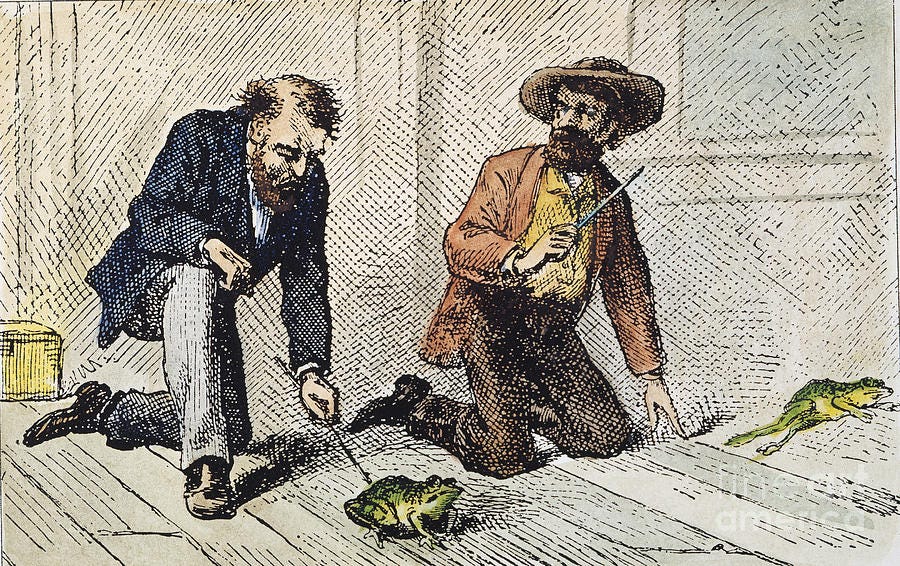
The story is about a narrator out west, who received a request from a friend to call on “good-natured, garrulous old Simon Wheeler” and ask after his friend Leonidas W. Smiley. The narrator dutifully visits Simon in a bar and asks about Leonidas, to which garrulous old Simon starts rambling about a Jim Smiley he knew.
Jim Smiley, Simon explains, once caught a frog and claimed it could outjump any bullfrog in the county. When a stranger offers a bet, Jim Smiley goes and fetches another frog for the man. While he is gone, the stranger pumps Jim’s frog full of quail shot so when the two men race the frogs, Jim’s frog is weighed down.
Here in the telling, old Simon Wheeler gets distracted, and the narrator scuttles away, convinced his friend out east had played a prank on him—that no Leonidas Smiley existed and the friend only wanted to trap the narrator with old Simon Wheeler.
That’s the gist of the story, which isn’t much longer than the paragraphs above that I used to describe it. So, what do we make of it?
I could see how this would be useful to teach in high school. The bulk of the story is a narrative within the narrative — Simon Wheeler telling the story of Jim Smiley to the narrator — so it would force a 15-year-old to pay attention to follow what was going on.
As a slice of life, we’ve all been there — gotten caught in conversation with someone loquacious, usually older, who operates on a different timetable and will keep you on a porch or at the bar for hours if you let him. Twain’s narrative rings true to what humans are like and the social absurdities we subject ourselves to.
As a good old-fashioned American yarn, it’s funny and fun to read, but I don’t have much else to say about it. To Twain’s point about criticism, maybe it’s enough to let a story be without any highfalutin commentary weighing it against a 114-point rubric.
.