

There’s an apocryphal quote out there, possibly originating with the poet Paul Valéry, that says, “You don’t finish a novel; you abandon it.” That’s good counsel, but if you plan to publish a book, you can’t abandon it until it goes to print.
With my own work, I’ll reach a point where the story is all set, the scenes and characters are all fixed, and everything feels polished and ready for print. But when I sit down to review it for a “final-final” round of review, I end up discovering little nits on every page.
Typos. Repeated words. Sentences to recast. It’s maddening.
Below, I’ve laid out a few line-level issues I tend to find at this stage. Using my most recent project as an example, I’ll lay out what’s going on, why I’m making the edit, and how I think the issue ended up on the page in the first place.
My goal is to offer tips to help you edit your own work. You might disagree with some of these notes, and that’s fine. We have objective rules of grammar and style, but line-editing is subjective. That’s what makes it fun.
Tip 1: Cut Filler Words
Someone once described writing fiction as running around after your characters with a notebook and trying to keep up. To get the scene on the page, we tend to reach for easy filler words.
My Achilles heel is the word look.
“She looked up.”
“He looked away.”
“She looked down the street.”
“He looked over.”
Look, look, look. In the line-editing phase, I’ll do a find search, and it’s not uncommon to find 200 uses of the word “look” over 300 pages.
The trouble is that in most cases, the author’s job is to be invisible. If you have a word like that every page or so, a lot of readers will spot it. Even if they don’t, I think it’s like a flickering fluorescent light, a subliminal agitation.
If you cut it down to 75 uses (every four pages or so), the reader is much less likely to notice or be aggravated by it. The trick is, you can’t simply replace it with a synonym:
“She glanced up.”
“His eyes cut away.”
“She gazed down the street.”
“He leered at her.”
You can do a little bit of that, but more likely the filler word is an opportunity to trim a line. Did you really need to have the character look up or glance or peer up? Is there something else she could do? Or could the dialogue continue without what you might call a “THAD” (a talking head avoidance device)?
Beyond look, other filler words include turn, that, just, very, suddenly, plus anything a character does between lines of dialogue — smile, shrug, laugh, sigh, nod, etc.
Tip 2: Trim ‘Directional’ Language
In my latest project, I had a chapter open, “The auto shop was on Highway 133 on the outskirts of Six Mile.” I revised the sentence to, “The auto shop was out near Six Mile.”
My rationale for this edit is three-fold: First, reading ahead, I referenced Highway 133 and used the word “outskirts” again on the next page. I didn’t need to have the information there twice, so one mention needed to go.
Second, the revised sentence is shorter. When I take on a manuscript for line edits, I’m always advising authors to “tighten.” I don’t want every novel sounding like Ernest Hemingway, but most of us are not William Faulkner. Less generally works better.
Third, “out near Six Mile” says essentially the same thing as “on Highway 133 on the outskirts of Six Mile” without the directional language. When you’re putting words on the page, you’re trying to see the scene, which sometimes leads to over-explaining.
“The cat was on the rug to the left of the door in front of the coat closet.” Why do we need to know all those details? Does it matter if the cat is to the left versus the right? It might be more direct to say, “He tripped over the cat on the rug.”
The directional language often seems to be the author trying to convince himself of the reality of the scene, but, perhaps counterintuitively, the voice comes of sounding less authoritative, as if the reader senses the author doesn’t fully believe in the scene he’s laying out.
A more authoritative voice assumes the reader knows a thing or two and trusts the reader to fill in the gaps. My favorite example might come from Denis Johnson’s “Work,” which I wrote about here. In it, the narrator enters a bar and observes, “Who should be pouring drinks there but a young woman whose name I can’t remember.”
Johnson doesn’t tell us, “I walked into the bar, which was at the back of the room, and behind the bar pouring drinks with her left hand was a 20-something redhead I’d seen before. She was about five-two and wore a tank top that revealed a dragon tattoo on her upper arm. I couldn’t remember her name.”
Instead: “Who should be pouring drinks there but a young woman whose name I can’t remember.” None of the other logistical details — where the bar is, what she looks like, whether she’s right- or left-handed — matter. Instead, the author trusts we can fill in the details about what a bartender looks like and gives us a laugh-out-loud line instead.
Tip 3: Watch for Homophones
Every writer has their thing. Too many dashes, commas on the wrong side of quotation marks, British spellings in an American novel, etc. One of my most frequent typos is the homophone — two words that sound the same but that have different spellings.
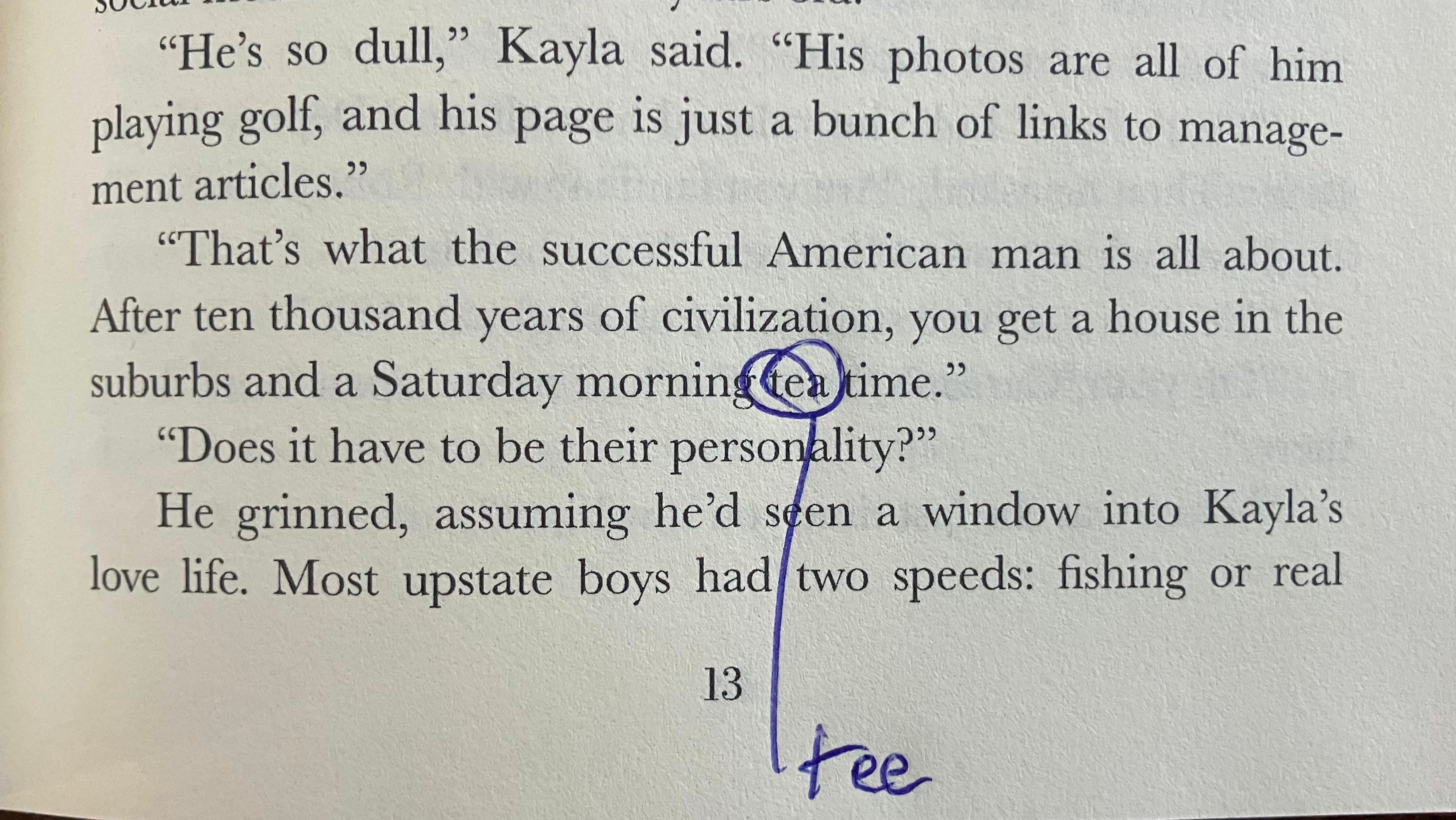
Hugely embarrassing, but here’s one I just caught: I referenced a guy’s Saturday morning “tea time,” which would have been fine if he were planning to sit down with a scone and a cup of Earl Grey. Instead, I meant a “tee time” for golf.
Spell check didn’t catch it — and wouldn’t catch it. I shudder to think where errors like this have worked their way into my finished work, but I’m sure they’re out there. My only advice is to read the story over and over and over again, and maybe also beg a few friends to read it, too.
Tip 4: Tighten Up
I already referenced this, but it’s worth saying again. In his book On Writing, Stephen King suggested that a second draft should be 10% shorter than the first draft. Some writers are naturally minimalists who need to add details as they go along, but a lot of you are maximalists who would do well to take King’s advice to heart.
I don’t have a conscious approach for this, but in addition to cutting filler words and directional language, I also think about sentence structure. Is there a way to reduce the number of verbs? For example, I revised this:
Luke stopped before going into the station. The door was open like she’d said. He scanned the area for security cameras and saw one on a corner of an eave. (30 words)
To this:
Before going inside, Luke scanned the scene. The door was open like she’d said, and a security camera hung from an eave. (22 words)
I’m not suggesting the second version is Shakespeare by any means, but I trimmed three sentences with four primary verbs (stopped, was, scanned, saw) down to two sentences with three primary verbs (scanned, was, hung).
Another example:
…imagining she was a middle-class country girl whose upbringing was much like his own.
To:
…imagining she was a middle-class country girl with an upbringing much like his own.
Both of these are the same length, but the second sentence cuts out the second “was.” It might be a pointless edit, but I suspect the reader’s brain takes in information one clause at a time. Replacing a dependent clause (“whose upbringing was much like his own”) with a phrase (“with an upbringing much like his own”) might require a little less mental focus to comprehend.
Tip 5: Remember the Reader
And that’s the point. I once saw the musician Tony Rice in a concert. At one point in the show, he paused to fiddle with his guitar. He leaned into the microphone and growled, “I tune because you care.” All of these notes are about making a smooth reading experience.
Happy editing.

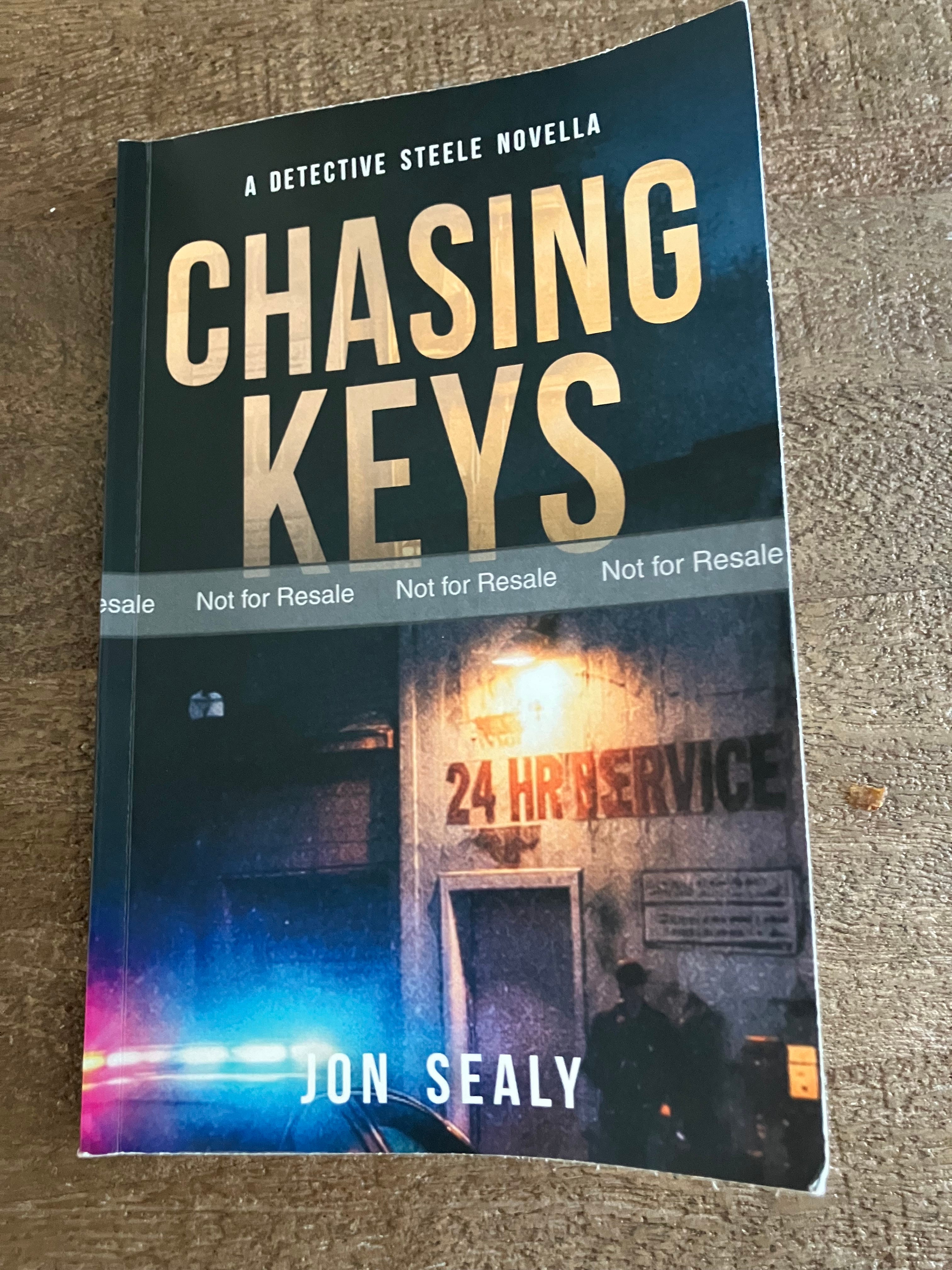
Cover looks good.
I liked how you described a type of person through his social media posts. There's also an economy of words/resources in describing him in rather oblique fashion instead of a long paragraph about his personality and habits.