Greetings from Glen Allen!
AI has been all over my news feed lately. AI Agents are about to take over all of white-collar work. People are using AI to flood the market with novels. Maybe we’re actually in the tech singularity.
I have three views:
If you haven’t been paying attention, AI can do more than you think.
Nevertheless, AI implementation is going to take longer than the tech bros think.
In the meantime, people are losing their minds.
Below, after a few bookish notes, I’ll expand on points 2 and 3. TLDR: Relax. Everything’s fine.
Until next month!
Jon

From Jon’s Substack
Three craft posts for you from the past month:
Bret Lott’s The Man Who Owned Vermont — what makes literary fiction “literary”?
The Strangeness of Leonard Michaels — discussion about his stories “Murderers” and “City Boy”
Writing Stories with Mr. Sealy — lessons on plot for fourth graders (and the rest of us)
The Elmore Leonard Podcast
I’m enjoying this and would recommend in particular the interview with mystery legend Otto Penzler and the interview with author Walter Mosley. Also of note, I missed this newish biography of Leonard last fall, C.M. Kushins’s Cooler Than Cool.
Elmore Leonard might be my spirit animal among writers: the boring suburban Dad with an enviable work ethic and an even more enviable body of wryly entertaining crime fiction.
And now to AI:
No, We’re Not in the Singularity
At least not in the sense that we’re weeks away from everything changing. If you aren’t retired, you need to keep up with what’s going on in the AI world, but the tech bros out there are all salivating over this happening:
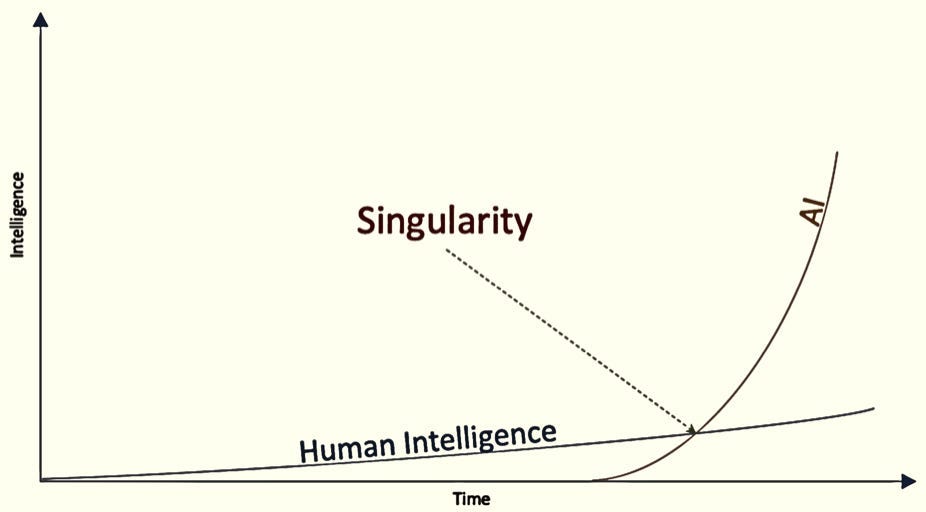
The idea is that AI superintelligence is imminent, and once it arrives, we’re going to experience a rapid and total disruption of human life. I wouldn’t rule anything out, but if you’re feeling anxious, here are two nuggets to calm you down.
(1) “It’s toasted.”
First, let’s say every little small business applies AI to their marketing. AI copywriting, AI design, AI agents running social media ads, yadda yadda yadda. Every plumber, every landscape business, every restaurant: Let’s say they hand over all of their digital marketing to AI overnight. What next?
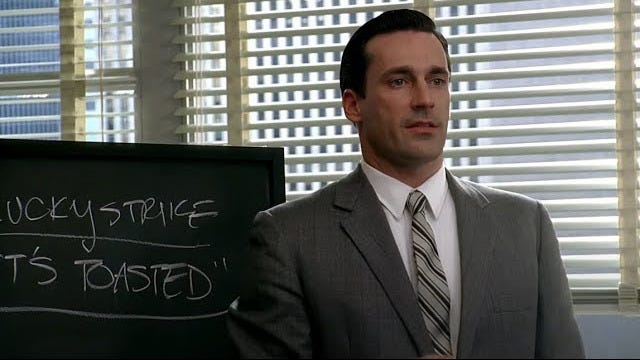
In the first episode of Mad Men, Don Draper is tasked with coming up with an ad campaign for Lucky Strike cigarettes. The rub is that new medical information has come out suggesting cigarettes are terrible for you, so how are you supposed to advertise around that?
Don is stumped until one of the executives says, “At least we’re all in the same boat.” Meaning, all the tobacco companies had the same problem, which Don realizes means none of them have the problem. They’re free to ignore the medical news altogether, and he comes up with the ad campaign “It’s toasted.”
Likewise, if every business suddenly leans on AI for marketing, where’s the competitive advantage? AI for Plumber A can’t out-think AI for Plumber B, so the advantage will go to the marketer who thinks outside the AI.
(2) AI as PowerPoint
My longstanding position on AI, at least where I sit as a writer, is that LLMs are like the invention of PowerPoint.
A generation ago, graphic designers spent gobs of time illustrating pie charts for corporate presentations. Then along comes PowerPoint and — boom! No need to pay an illustrator to do that anymore.
Rather than wiping out graphic designers and illustrators, however, PowerPoint ushered in a new era of design, where graphic artists could spend their time thinking about more important tasks than financial pie charts.
There’s going to be no shortage of work even after AI starts automating the tasks we do today. The transition might be rocky, but “work” is human. No matter how much we automate, there’s always going to be more work.
“But what are my children going to do?”
When I was my children’s age, my parents could not have envisioned the work I do today. What of it? I figured it out, and our children are going to figure it out, too.
Meanwhile, People Are Losing Their Minds
Which brings me to this post I saw recently on X, where tech-adjacent bro Jason Crawford wrote:
The question of AI personhood may be the most important question of the 21st century.
Getting it wrong in either direction would be an epic disaster: False negative → we become history’s greatest slave-drivers. False positive → we cede the future to p-zombies.
Let me stop you right there.
There is no question of AI personhood.
AI is not — and never will be — sentient. AI bots and agents aren’t people, not even in the Mitt Romney “corporations are people” sense. AI is a tool, and its creators and/or users are accountable for its activities, same as if it were an automobile.
The fact that “AI personhood” is being brought up at all is evidence that people still pose the greatest risk for humanity on this side of eternity.